
It’s Autumn! The kids in the UK and Europe have all gone back or started new schools. We started our new study year too so we thought it might be a nice time to write about how we go about ‘schooling’ or ‘educating’ the kids.

‘Why aren’t you at school?’
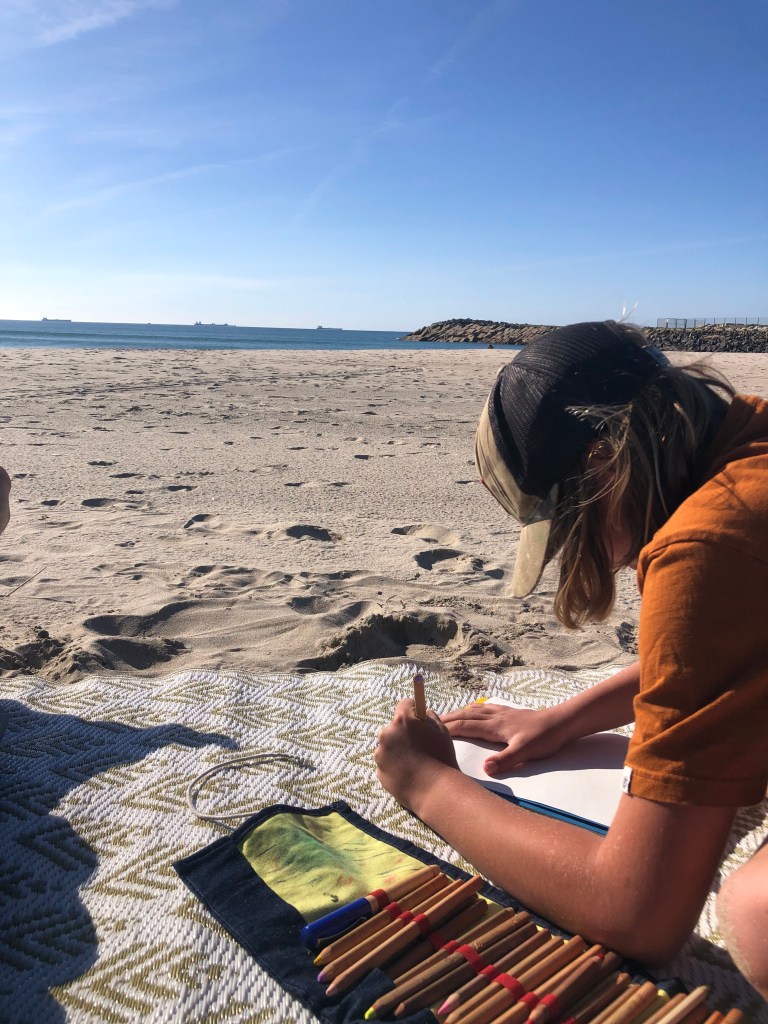
Whenever we’re out and about, the children are always asked why they are not at school. People always ask the kids, never us parents. Maybe some of them just want to check that the kids are ok and happy. Either way I don’t mind as both Sebby and Remi proudly respond, ‘I’m homeschooled’.
The person then turns their attention to us, the parents and normally ask “how do you do that?” Our answer will differ from person to person or situation. You can just tell those that require a summary of the what, where and how and those that are after a little more information. The kids chat and interact effortlessly which usually softens the hardest of pro-schoolers, proving that home-schooled children are well adjusted, able to integrate and communicate proficiently and are generally interesting and articulate.
On occasions, we get people who say things like “I wouldn’t deny my children a decent education” in which case we reply, that’s great. Because, just like us as human beings, education is not a one-size-fits-all programme and what’s good for one child may be different for another. Not to mention that children, their development, social groups and individual needs are always changing so it is natural that the educational settings might need a change up throughout the life cycle of a child. We’re not at all rigid to this style of education for our children. Right now it’s working for them, us and the life situation we currently find ourselves in. However, if any of that changes for any of us, we are totally happy to step in a new direction.

Thank you UK for allowing Home Education
Although there are campaigns to stop homeschooling, the UK is one of the few countries in Europe that allow home education. Not only that, at the moment parents have the freedom to choose their educational path. No matter how social norms try to mould us into the rigid national curriculum structure of primary and secondary schooling, there is an abundance of options out there for those that need to widen their educational horizons. These include, unschooling, world schooling, nature-based learning, creative schooling, co-educating, centres, groups and a multitude of other really cool and interesting options.

Our Waldorf Steiner Schooling
Our path so far has been via the Waldorf Steiner curriculum. This is a holistic educational approach emphasising on creativity and individuality. It’s based upon the philosophy or Rudolf Steiner where children are encouraged to learn through arts-integrated learning. Academics are integrated with artistic and practical subjects, nurturing well-rounded development and a deep connection to nature. There are approximately 1,100 Waldorf Steiner Schools in 80 countries around the world.
Our children both attended the Brighton Waldorf School, both from the ages of three years old where they started their journey at Kindergarten. Both children enjoyed a rhythm of play, work, creativity and connection to nature. They didn’t start any sort of formal learning until they were six and a half years old. So for Remi, formal learning has just started now.

Home Education – what we learn
As mentioned above, we follow the world-wide Waldorf Steiner Curriculum, which is so very accessible. You can buy a variety of <a href=”http://<a target=”_blank” href=”https://www.amazon.co.uk/s?k=waldorf+steiner+books&crid=2Q7H6MT5HLKDI&sprefix=waldorf+steiner+books%252Caps%252C125&ref=nb_sb_noss&_encoding=UTF8&tag=thewanderingf-21&linkCode=ur2&linkId=99b803e9a3a0dd61fbddddc2b63e3eaf&camp=1634&creative=6738″>Booksbooks that detail the curriculum and there are plenty of resources out there that support both teachers and parents in teaching to the curriculum. The problem is that the Waldorf Steiner approach is so very special and the magic of that is transferred from teacher to child. Teachers generally live and breath the philosophy, making their teaching so pure and from a soul-led space. Unless you have undergone the teacher training of have come from a Waldorf background yourself, it is very hard to deliver the full Steiner experience at home. I’ve tried it! And, if I’m honest, I found it awe-inspiring, beautiful, overwhelming and exhausting all at the same time.
Fortunately, there are a range of options out there for families and communities that would like to Home School the Waldorf Steiner way. We have found a wonderful lady called Imogen at Waldorf-Inspired Home Schooling that produces lesson plans that makes the whole experience so much brighter for all of us. This means I can transfer my energy into supporting and engaging in the children’s learning from the lesson plans already lovingly created by a true Waldorf teacher.
Remi has started her first year of formal learning. I say formal, but really it isn’t. It’s beautiful and it’s all done through a creative approach of story telling, song, verse and artistry. This year she will be introduced to all the letters of the alphabet, writing and reading, numbers from 1 to 100 and the four processes (addition, subtracting, division and multiplying). She’ll learn to use her own true voice through song and verse and will put those busy hands to good use making natural seasonal crafts and knitting.
Seb has just started class 5, which is the equivalent to year 6 in primary school. This year Seb will be chuffed to be learning a lot about Greek Mythology, Ancient Egypt, Botany and wider geography. These topics will be blended into all other subjects including Maths, English, Sciences and Art.
As well as the holistic and artistic approach to learning, I love following the Waldorf Steiner curriculum because it ensures that we slow down the children’s learning in this fast-paced life. There are no computer screens and the children are encouraged to embody all that they learn. Seb’s learning really thrives through story and Remi learns through movement and practical ‘doing’ so right now, this method of home education is working us.
What else we learn through World Schooling
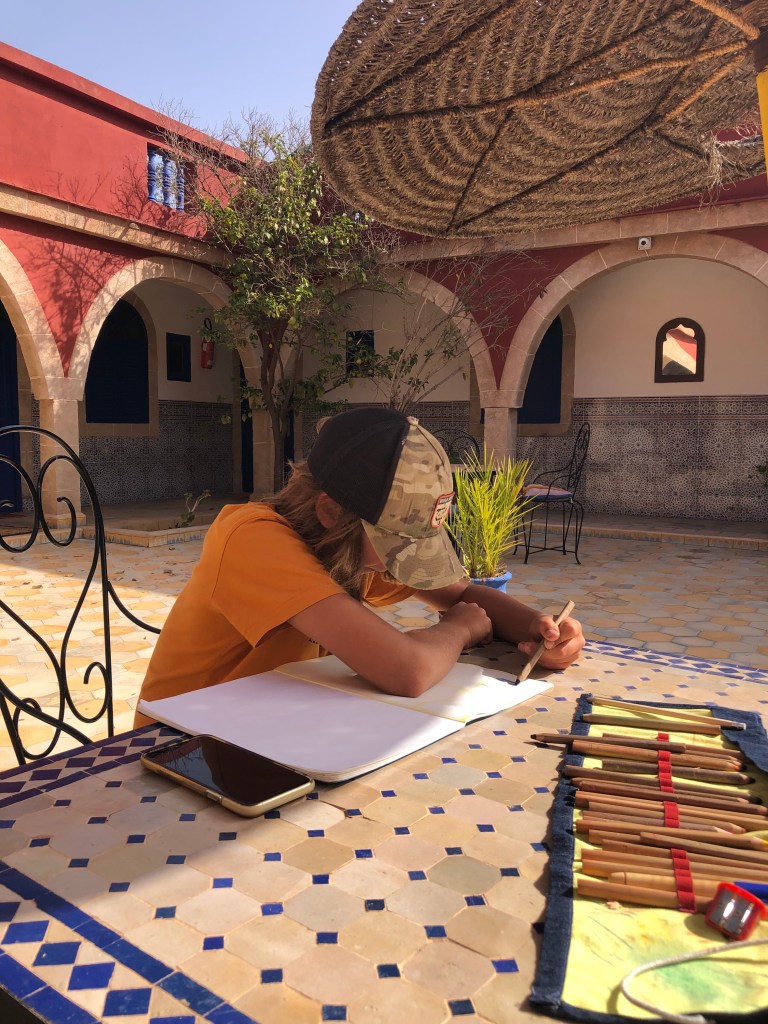
In addition to the more formal learning, the children learn from every experience they encounter, both from travelling but also the opportunities that arise from having more time to explore their surroundings or interests.
We encourage them to learn a language, pick up an instrument when they feel called to and follow whatever interests they have. At the moment, we don’t stay in one place long enough for the children to enrol in team or competitive sports but both love to try new activities when the opportunity arises. Regular physical activities include board sports on all plains; surfing, skating, and snowboarding, as well as cycling, swimming, running, diving, fishing, dancing and trials riding. We also love to walk our three eager Springer Spaniels.
They are lucky to learn so much through travel. There is a huge amount of life-skills to be learnt every day, understanding a countries culture and history and how to navigate through life physically, emotionally and mentally. Communication and social skills are nurtured through interaction with a great range of people and the need to make new friends regularly – there’s a post on that here.
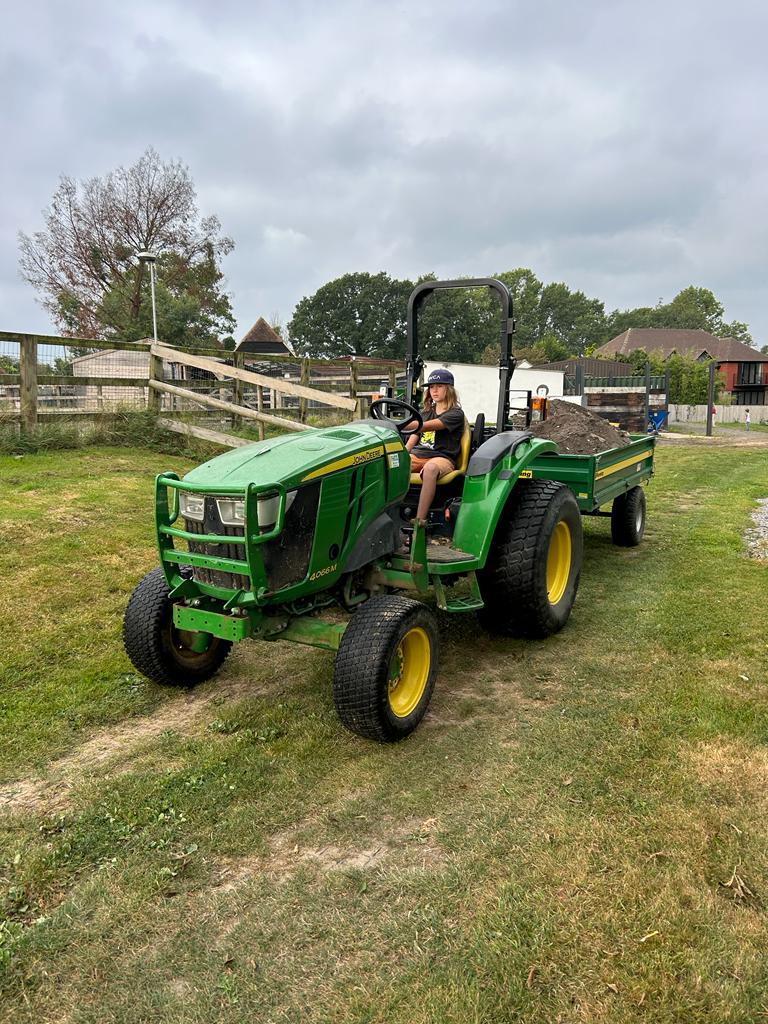
We’ve also really enjoyed seeing how many opportunities the kids get to experience just through having more time to be available to them. The extra time to explore is beneficial to everyone. Seb has learnt to drive a range of vehicle, vessels and machinery. Remi has learnt a wide range of skills from hanging out with people of all ages, backgrounds and languages.
When and How do you Home School?
I can’t say we home school every week day. Some days are travel days where we have to set off early. Some days are just full of other things and experiences. We always prioritise hanging out and play time with other kids too.
What we do know is what we want to complete come the start of the next school year. The amount of sit-down school time will then slow down and accelerate depending on what else is going on.
The kids definitely find it easier to knuckle down in the mornings so we try to get the school work done then, after a bit of movement and before lunch.
Sometimes that just doesn’t work out like today when Remi carried out her school work before dinner and Sebby after.
Sometimes I have them working at the same time and sometimes separate times. There is no perfect scenario for us so we try to let go of perfect. Sometimes they just can’t be together because the annoy each other, argue, fight for my attention or are far too cheeky to get anything done.
We tend to be outside a lot of the time but on rainy day’s in the camper, I’ll have one at the table and one in the bedroom if need be. We just do what we can and remember again to let go of perfect.
I keep banging on about ‘letting go of perfect’. But to me it’s fundamental to being able to do this homeschooling thing. Obviously we want the best for our children always and in every way. But, there is a fine line between doing your best in that moment and ridiculing yourself with a barrage of self doubt and unworthiness if you feel that nothing but perfect will do. And compounding that demoralising thought; that you should hold that perfection for everyone, all of the time. There is learning for all of us if we surrender to that simple mantra “I’m doing my best and that is enough”. After all, if you as the parent are stressed, that ripples out in energy to your kids. My top tip for stressful moments, (although not always followed by myself) is to stay present and notice when tension is rising in you and suggest a break for a few breaths and a glass of water.

An Example of our Home School Day
So, a typical (although not always) day for us would look something like this:
- Wake up slowly and all do our individual thing
- Join together for breakfast
- Take the dogs out for a walk
- Move our bodies – maybe a swim, walk, basketball, surf
- Find somewhere to settle for school work
- Light a candle
- The children recite their morning verse, read aloud poems and songs
- School music practice
- Main lesson work
- A story relating to what they’re learning
- Break for a snack and a move about
- Subject lesson for Seb and craft, painting or handwork for Remi
- Lunch
- Whatever they choose for the rest of the day
- Reading before bed
- Sleeeeeeeeeeeeep
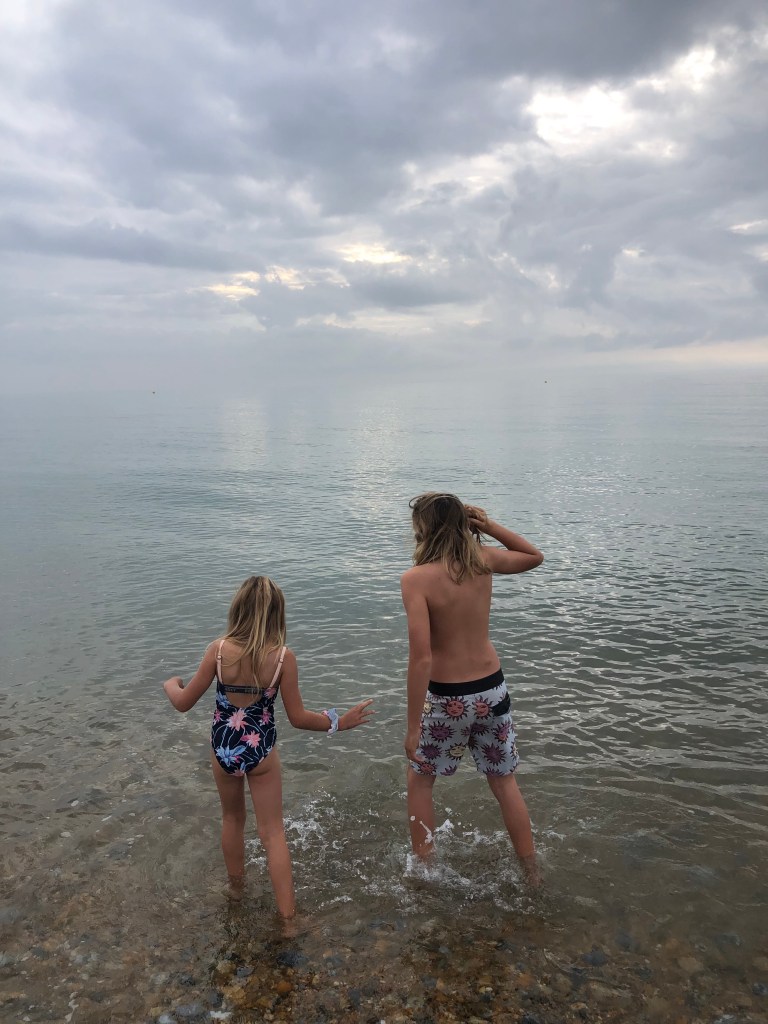
What the Children Say About Home Schooling
The children still love to hang out with their old Brighton Steiner school friends when they’re home and nurture their friendships with regular communication when we are away. So in that way they still feel very connected to school.
They really enjoy a life that is not ‘rushy’ – no more flying out the door with half a piece of toast, one shoe and a very flustered Mummy for us! The slower pace does them both a lot of good.
They enjoy all the opportunities that are available to them and they actually (at these ages) like all being together. They find the work quite fun and engaging on the whole and love the fact that school work does not take up the whole of the day.
Mostly they like the fact that we can travel when we like and have the freedom to follow the path that we choose. They have autonomy over their learning and if things aren’t working, they can tell us and we’ll come up with a plan B.
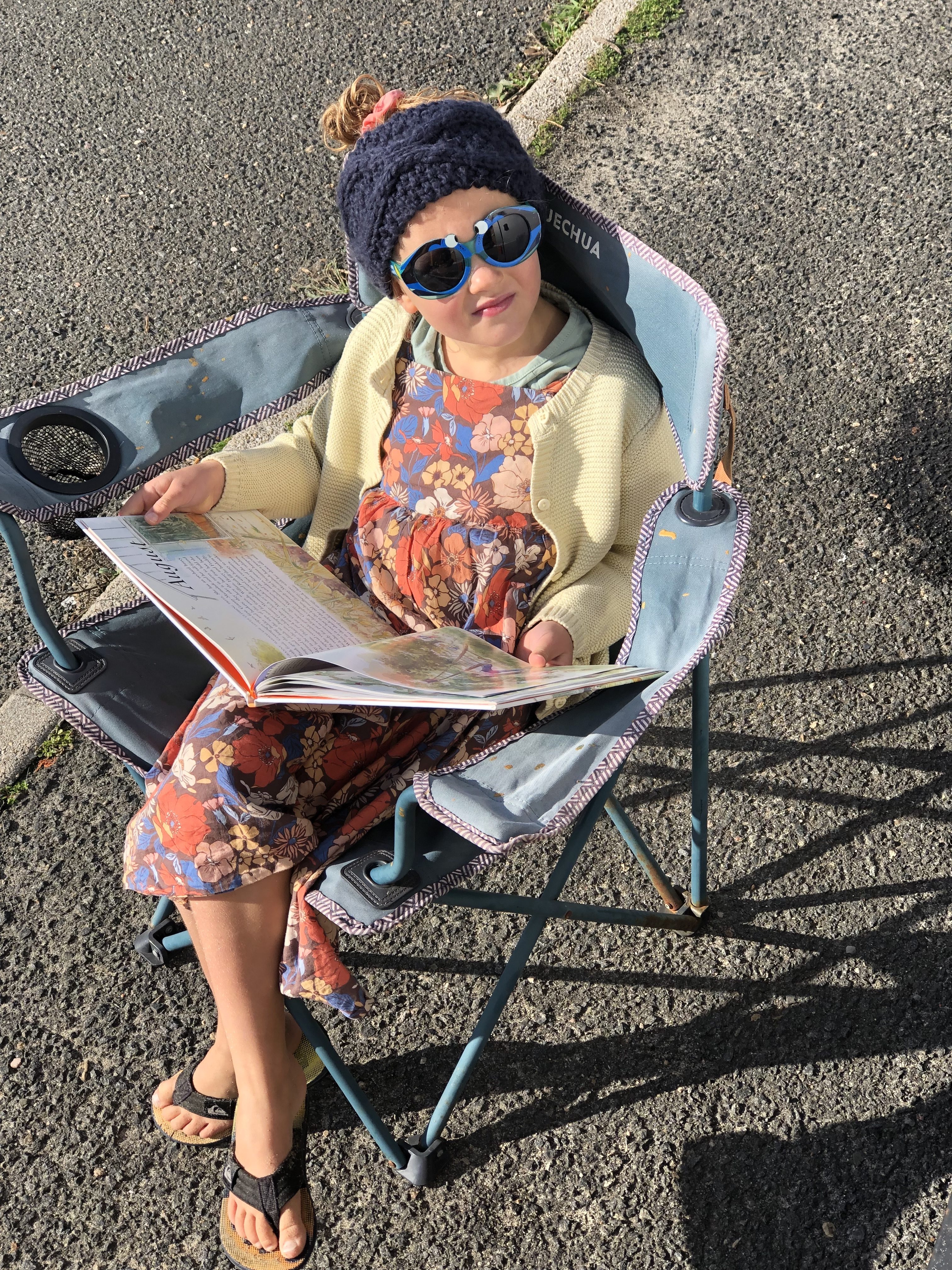
Home Educating Older Children
We don’t know how the children will feel as they get older but what we do know is that we are happy to move their education in whatever direction the children would like. At the very young ages of six and ten, the children have ambitions of becoming a vet and an architect. No doubt this may change as they grow but we see no reason why this home education pathway will not be able to lead them to their destination.
There are numerous options for teenagers and young adults outside of the national curriculum. Plus internationally recognised qualifications such as IGCSE’s which are flexible and allow kids to tailor their studies to their interests, career goal or desired university qualification.

So that’s us and our homeschooling. We would love to hear about your homeschooling journey. We’re also always super happy to chat and discuss the good times and the hard times (because like with anything, there are hard times sometimes too). Community is alway so important and it’s truly what we love about this family nomadic life.
With love and kindness.
The FamiLee x


 The Wandering FamiLee
Leave a reply to Jon Cancel reply